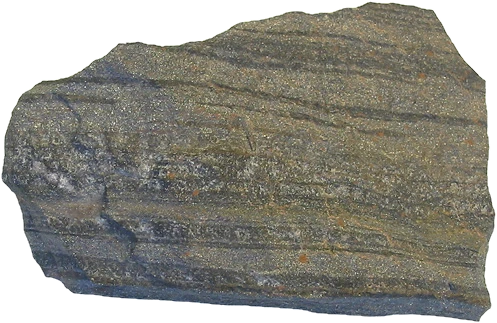
Staurolite
A cross-shaped mineral used to gauge metamorphic conditions.

Staurolite is a reddish brown to black, mostly opaque nesosilicate mineral with a white streak. It crystallizes in the monoclinic crystal system, has a Mohs hardness of 7 to 7.5, and the chemical formula Fe2+2Al9O6(SiO4)4(O,OH)2. It is notable for its characteristic cruciform penetration twinning, which gives it a cross-shaped appearance.
- chemical_formula
- Fe2+2Al9O6(SiO4)4(O,OH)2
- crystal_system
- monoclinic
- hardness
- 7 to 7.5
- streak
- white
- color
- reddish brown to black
- known_for
- cruciform twinning and use as an index mineral in metamorphic geology
Lore & Background
Staurolite often occurs twinned in a characteristic cross-shape, called cruciform penetration twinning. In hand samples, macroscopically visible staurolite crystals are prismatic, and the mineral frequently forms porphyroblasts. In thin sections, it is commonly twinned and shows lower first order birefringence similar to quartz, with the twinning displaying optical continuity. It can be identified in metamorphic rocks by its swiss cheese appearance (with poikilitic quartz) and often mantled porphyroblastic character.
Reader's Guide
Staurolite is a regional metamorphic mineral of intermediate to high grade, occurring with almandine garnet, micas, kyanite, albite, biotite, and sillimanite in gneiss and schist. Its significance lies in its role as one of the index minerals used to estimate the temperature, depth, and pressure at which a rock undergoes metamorphism. This makes it a key tool for geologists studying metamorphic processes. The mineral is the official state mineral of the U.S. state of Georgia and is also found in the Lepontine Alps in Switzerland. Notable localities include Fannin County, Georgia; Fairy Stone State Park in Patrick County, Virginia; Island Park, Idaho; Taos, New Mexico; near Blanchard Dam in Minnesota; and Selbu, Norway. The name derives from the Greek 'stauros' for cross and 'lithos' for stone, referencing its common twinning.
Did You Know?
- Staurolite is named from the Greek 'stauros' for cross and 'lithos' for stone, due to its common cruciform twinning.
- It is the official state mineral of the U.S. state of Georgia.
- Staurolite is used as an index mineral to estimate the temperature, depth, and pressure of metamorphism.
- It is most commonly found in Fannin County, Georgia.
More in Minerals & Ore Deposits 1-24
Elsewhere in the Minerals & Ore Deposits universe
Spotted an error? Know more?
This is a living reference — every entry is fact-audited, and reader corrections feed straight into our audit queue. Suggest an edit · See this site's audit record