Pentlandite
Key nickel ore found in ultramafic rocks.

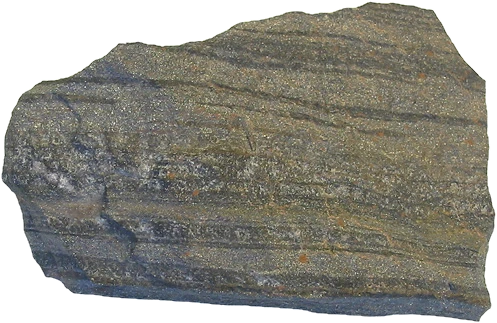
Pentlandite is an iron–nickel sulfide mineral with the formula (Fe,Ni)9S8, notable for being one of the most important sources of mined nickel. It is found in abundance within ultramafic rocks and occurs in massive granular aggregates, typically with a yellowish bronze color and metallic luster.
- chemical_formula
- (Fe,Ni)9S8
- hardness
- 3.5–4
- specific_gravity
- 4.6–5.0
- color
- yellowish bronze
- luster
- metallic
- streak
- light brownish bronze
- magnetism
- non-magnetic
Lore & Background
It forms isometric crystals but is normally found in massive granular aggregates. It is brittle and non-magnetic, with a hardness of 3.5–4 and specific gravity of 4.6–5.0. In the field, it is often confused with other brassy yellowish sulfide minerals, but can be distinguished by its paler color, lack of magnetism, and light brownish bronze streak.
Reader's Guide
Pentlandite is the most common terrestrial nickel sulfide and a primary ore of nickel. It typically forms during cooling of a sulfide melt, often within mafic and ultramafic melts. Major occurrences include the Bushveld igneous complex (South Africa), Voisey's Bay (Canada), the Duluth gabbro (North America), and Kambalda-type komatiitic deposits in Western Australia. The Sudbury Basin in Ontario, Canada, is associated with a meteorite impact, where pentlandite-chalcopyrite-pyrrhotite ore formed from sulfide melts. Metamorphism can alter its texture and composition, sometimes producing porphyroblastic 'fish scales' of pentlandite. Its significance lies in its role as a dominant nickel ore, supporting global nickel production.
Did You Know?
- Pentlandite is named after Irish scientist Joseph Barclay Pentland, though he did not discover it; the mineral was first described from Sudbury, Ontario, and named in his honor by others.
- The nickel to iron ratio in pentlandite varies; while often close to 1:1 in some samples, the formula (Fe,Ni)9S8 allows for a range of Ni:Fe ratios.
- Pentlandite is non-magnetic, unlike some similar sulfide minerals.
- Pentlandite is primarily associated with magmatic sulfide deposits in ultramafic rocks, not with 'black smoker' hydrothermal vents.
Frequently Asked Questions
Who is Pentlandite?
Pentlandite is an iron–nickel sulfide mineral with the formula (Fe,Ni)9S8, widely recognized as one of the principal ores from which nickel is extracted. It typically occurs as massive granular aggregates hosted within ultramafic rock formations.
What are Pentlandite's powers/role?
Its defining role in the ore world is supplying nickel in large, easily accessible concentrations. It sits at a Mohs hardness of roughly 3.5 to 4 and carries a specific gravity between 4.6 and 5.0, giving it a notably dense, heavy character.
How does Pentlandite's story end?
In the real-world narrative, Pentlandite's arc concludes when it is smelted and refined to recover its nickel and iron for industrial applications. Because it forms in large, concentrated deposits, it is comparatively straightforward to process relative to more scattered nickel-bearing minerals.
Why is Pentlandite important?
It stands among the most economically significant nickel ores on the planet, underpinning industries that rely on nickel for stainless steel, rechargeable batteries, and specialty alloys. Its abundance within ultramafic bodies allows for large-scale, cost-effective mining operations.
What does Pentlandite look like?
Pentlandite shows a distinctive yellowish-bronze hue with a bright metallic luster, and its streak registers as a light brownish-bronze. These visual cues help field geologists and collectors set it apart from other sulfide minerals at a glance.
More in Minerals & Ore Deposits 1-24
Elsewhere in the Minerals & Ore Deposits universe
Spotted an error? Know more?
This is a living reference — every entry is fact-audited, and reader corrections feed straight into our audit queue. Suggest an edit · See this site's audit record